
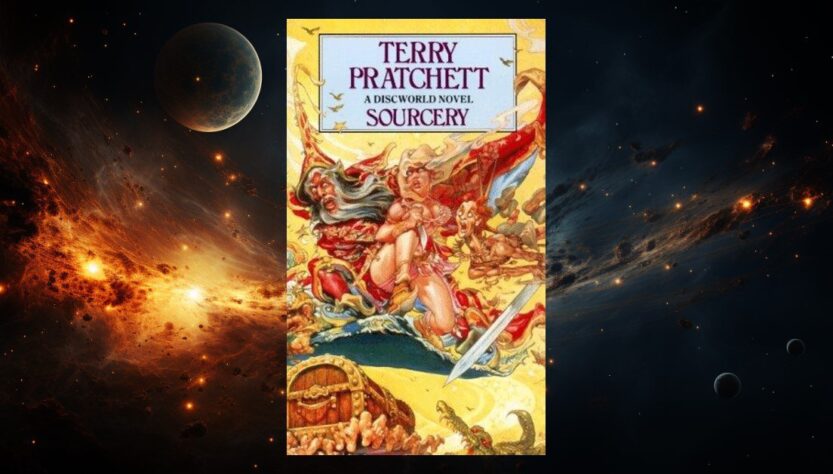
Coming back to Sourcery after reading deep into Discworld, it feels like a book from the point where Pratchett clearly knows this world has legs, but has not quite locked in the balance that makes the later classics so effortless. There is loads of invention here, plenty of sharp lines, and a sense that the whole thing could tip over into complete magical catastrophe at any moment, which is part of the fun.
This is also one of the more overtly fantasy shaped early Discworld books. The jokes are still there, obviously, but the novel leans harder into wizardry, prophecy, barbarian archetypes, eldritch escalation, and the general absurdity of what happens when too much power lands in exactly the wrong hands. If you like Pratchett most when he is sending up the furniture of epic fantasy itself, there is a lot to enjoy.
What works
The central idea is excellent. A source of magic producing a sourcerer, effectively a wizard squared, is exactly the kind of concept that gives Pratchett room to turn magical arms races into both spectacle and satire. It lets him poke at power, ambition, and the tendency of supposed wise men to become absolute idiots the moment a bigger spellbook appears.
Rincewind remains a great lens for this sort of story. He is not heroic in any conventional sense, which is precisely why he works. Watching a cosmic level magical crisis unfold through the eyes of a man whose main talents are panic, survival, and running away gives the book much of its energy. The Luggage is also, as ever, a wonderfully stupid and perfect creation.
There are moments here that really land, especially if you enjoy the more metal, mythic side of fantasy being filtered through Pratchett’s comic sensibility. The imagery gets bigger, stranger, and more apocalyptic than in some of the earlier books, and there is a scrappy ambition to the whole thing that I found very endearing, even when it does not fully come off.
Why it is a 3 rather than a 4 or 5
For me, this sits firmly in the interesting rather than essential tier of Discworld. It has a strong premise, but it lacks some of the control, warmth, and precision that Pratchett develops later. The book is often funny, but not consistently hilarious. It is imaginative, but also a bit lumpy.
Part of that is simply where it sits in the evolution of the series. The characters do not yet have the depth or rhythm that the best Discworld books achieve, and the satire is broader, sometimes closer to parody than the richer social observation Pratchett would become so good at. The plotting can feel more like a sequence of escalating set pieces than a story with the clean inevitability of the later standouts.
There is also a slightly shoutier quality to Sourcery. Everything is turned up, the magic, the stakes, the weirdness, the destructiveness, and while that absolutely suits the premise, it means the book can feel more exhausting than elegant. I enjoyed it, but I never quite loved it.
Who it will click with
If your favourite Pratchett is the sharper, more humane, more character led stuff, think Guards! Guards!, Small Gods, or Going Postal, this one may feel like an earlier and rougher model. If, on the other hand, you enjoy the wild energy of the first few Discworld books, or you have a soft spot for fantasy pastiche with actual ideas behind it, Sourcery has plenty to offer.
It is probably best thought of as a fascinating early Discworld novel rather than a top shelf one. Not peak Pratchett, but still unmistakably Pratchett.
Final thoughts
Even at 3 out of 5, this is the sort of 3 that comes from a very high ceiling. Lesser authors would kill for this level of imagination. Sourcery just happens to sit in a series that eventually produces some absurdly tough competition. It is big, messy, clever, and occasionally brilliant, but not one of the books I would hand to a new reader as their first taste of Discworld.
Rating: 3/5
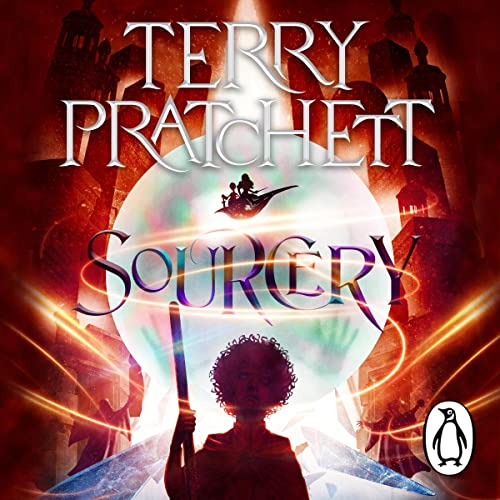
The Audible UK edition is narrated by Colin Morgan, with Bill Nighy reading the footnotes and Peter Serafinowicz as Death, and runs to 9 hours.
Discover more from Unfolded Universe: Sci-Fi Book Reviews
Subscribe to get the latest posts sent to your email.